
1. When you plant lettuce, if it does not grow well, you do not blame the lettuce.
— Thích Nhất Hạnh
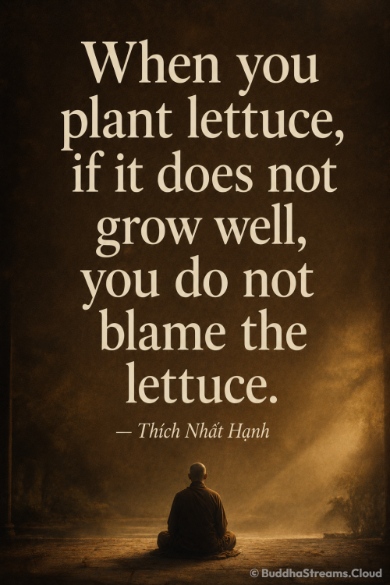
We are remarkably patient with plants and remarkably impatient with people. A gardener does not curse the seed that struggles. She looks at the conditions. Is there enough water? Enough light? Enough care? Thich Nhat Hanh uses this image to point gently at how we might approach the difficult people in our lives, and also ourselves. When something is not growing well, blame is rarely the answer. Understanding the conditions is always the wiser place to begin.
2. Anger is like a storm rising up from the bottom of your consciousness.
— Thích Nhất Hạnh
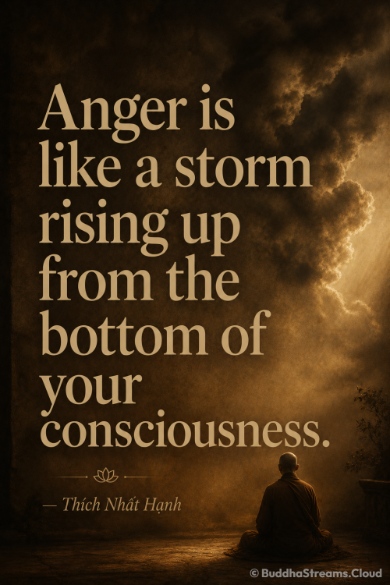
Anger does not appear out of nowhere. It rises from somewhere deep inside us, from old wounds, from unmet needs, from accumulated pain we never fully processed. Thich Nhat Hanh gives us this image so we can understand rather than fear our anger. A storm can be terrifying, but it is also completely natural. It was always there beneath the surface, and it will pass. Understanding where the storm comes from is the first step toward not being destroyed by it.
3. When another person makes you suffer, it is because he suffers deeply within himself.
— Thích Nhất Hạnh
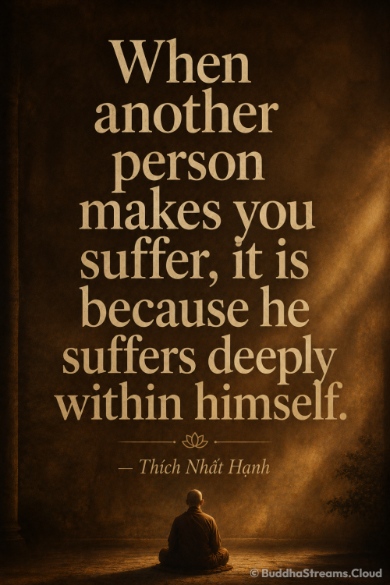
This does not mean that harmful behavior should be excused or accepted. But it does offer us something powerful: understanding. The person who spoke harshly to you today was not operating from fullness. They were pouring from an empty and wounded place. Thich Nhat Hanh is not asking you to absorb mistreatment with a smile. He is offering you a way to see clearly without being consumed by bitterness. Understanding the source of cruelty is not weakness. It is wisdom.
4. The basis of happiness is understanding. The basis of love is understanding.
— Thích Nhất Hạnh
We often go looking for happiness in the wrong drawers. We search in achievements, in pleasures, in approval from others. But Thich Nhat Hanh points to something deeper and more dependable. When you truly understand someone, why they behave the way they do, what they are carrying, what they fear, it becomes almost impossible not to love them. And that love, the kind rooted in real understanding, is the only kind stable enough to last.
5. To be loved means to be recognized as existing.
— Thích Nhất Hạnh
At the very heart of loneliness is the feeling of not being seen. Not being recognized. Not mattering to anyone. Thich Nhat Hanh captures one of our most essential human needs in a single sentence. Love is not only romance or affection. It is the acknowledgment that someone else is real, that they are here, that their presence makes a difference. The next time you look at someone, truly look. That act of recognition is one of the purest forms of love available to any of us.
6. Reconciliation is to understand both sides, to go to one side and describe the suffering being endured by the other side.
— Thích Nhất Hạnh
True reconciliation is not about deciding who was right. It is about having the courage to carry one person’s pain to another person’s door and say, look, they are hurting too. This is the hardest kind of peacemaking. It asks us to hold two truths at once, that we suffered and that someone else suffered too. Thich Nhat Hanh built his entire peace work on this principle. Not sides. Not winners. Just two human beings, both in pain, both deserving of being understood.
7. Letting go gives us freedom, and freedom is the only condition for happiness.
— Thích Nhất Hạnh
Think about what you are holding right now that is no longer serving you. An old grudge. A version of yourself that does not fit anymore. An expectation that keeps being disappointed. Thich Nhat Hanh is not telling you that letting go is easy. He is telling you what it costs you to keep holding on. Freedom is not found out there somewhere in better circumstances. It is found the moment you open your hands and release what you have been gripping so tightly for so long.
8. Fear keeps us focused on the past or worried about the future.
— Thích Nhất Hạnh
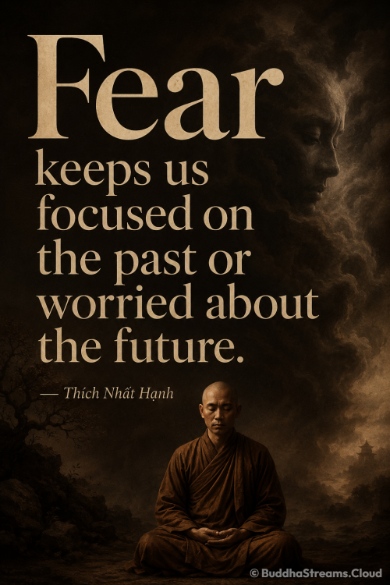
Fear is a time traveler. It pulls you backward into what already happened or forward into what might happen. What it almost never does is bring you here, to this moment, which is the only place where life is actually occurring. Thich Nhat Hanh is not saying fear is bad or that you should not feel it. He is simply pointing out where it lives and what it costs you. The present moment is the one place fear cannot fully follow. That is where your freedom lives.
9. The most important thing is not what we do but what happens inside us while we are doing it.
— Thích Nhất Hạnh
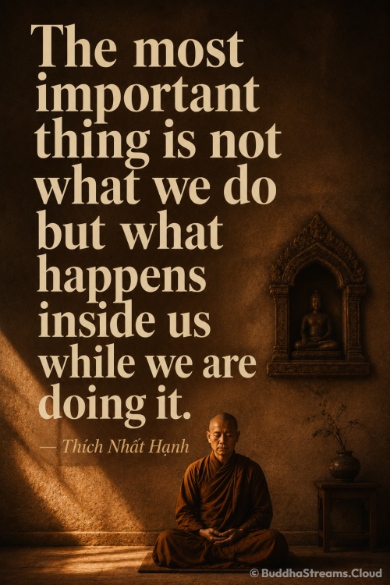
Two people can perform the exact same action and have completely different inner experiences. One washes dishes with resentment, the other with gratitude. One walks to work in anxiety, another in wonder. Thich Nhat Hanh understood that the quality of a life is not measured by what tasks get completed. It is measured by the presence and intention we bring to even the smallest of them. Any ordinary moment can become a practice. The doing is not the point. The being is.
10. Non-self is not a doctrine. It is an experience.
— Thích Nhất Hạnh
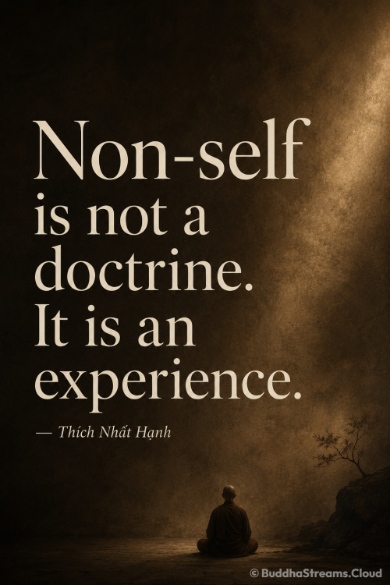
We spend enormous energy protecting and promoting the self, the story of who we are, what we deserve, how we have been wronged, what makes us different from others. Thich Nhat Hanh does not ask you to accept a philosophical idea here. He invites you into an experience. The moment you drop into true presence, the edges of self begin to soften. Something larger holds you. This is not frightening. Those who have touched this experience describe it as the deepest peace they have ever known.
11. Sometimes we feel empty; we feel a vacuum, a great lack of something. We don’t know the cause; it’s very vague.
— Thích Nhất Hạnh
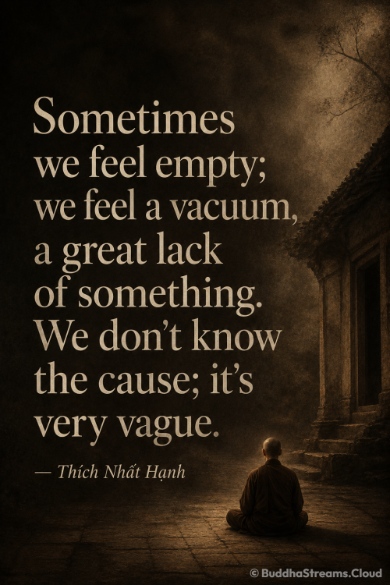
This kind of emptiness is one of the most honest descriptions of modern human experience. We cannot always name what is missing. We just feel a hollow space that no amount of scrolling or purchasing or achieving seems to fill. Thich Nhat Hanh does not offer a quick fix here. He simply does what a good teacher does. He names what is real. And in the naming, something shifts. To have your experience recognized, even by a quiet voice from a page, is the beginning of understanding. And understanding is the beginning of peace.