
12 Shunryu Suzuki Quotes for the Spiritual Seeker Who Is Trying Too Hard
1. To live in the realm of Buddha nature means to die as a small being, moment after moment.
— Shunryu Suzuki
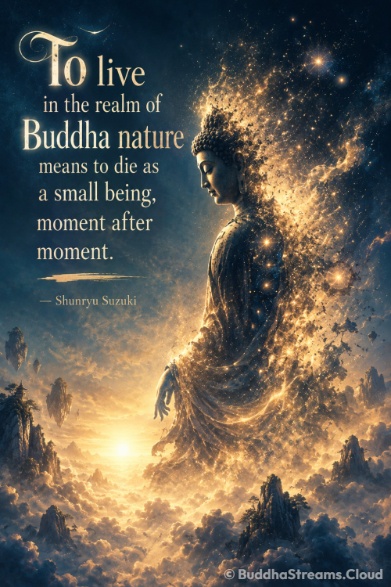
What Suzuki calls the small being is the defended, self-protecting, reputation-managing self we carry around and work so hard to maintain. He is not asking us to destroy it. He is pointing out that in every genuine moment of presence and openness, it naturally releases itself, just a little. And in that releasing, something larger and more alive comes forward. This is not dramatic. It is quiet. It happens in small ways in small moments. But accumulated across a lifetime, it is everything.
2. We should find perfect existence through imperfect existence.
— Shunryu Suzuki
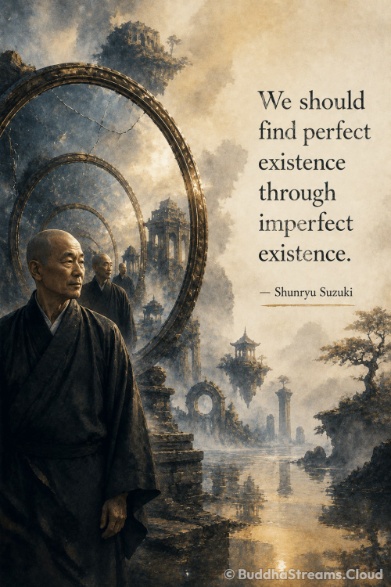
This is Suzuki at his most honest and most compassionate. He is not asking you to become perfect before life becomes meaningful. He is telling you that the imperfection is the material. The crack is where the light gets in. Your limitations, your failures, your unanswered questions, none of them disqualify you from genuine spiritual life. In fact, for Suzuki, they are exactly the conditions in which the deepest practice becomes possible. Perfection would leave you nothing to work with.
3. It is not some special way of doing things. It is a way of doing everything.
— Shunryu Suzuki
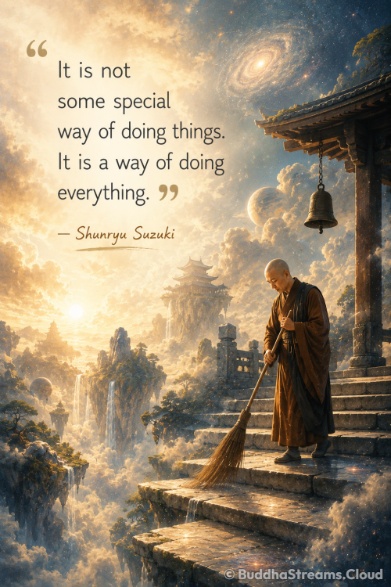
We tend to separate life into two categories: the things that matter and the things that are just logistics. Suzuki collapses this division entirely. The Zen way is not a special hour of the day set aside for something sacred. It is the quality of attention brought to every single hour. The way you listen matters. The way you chop vegetables matters. The way you respond when you are tired and someone needs you matters. There is no moment that is spiritually neutral. Everything counts. Everything is the practice.
4. Strictly speaking, there are no enlightened people. There is only enlightened activity.
— Shunryu Suzuki
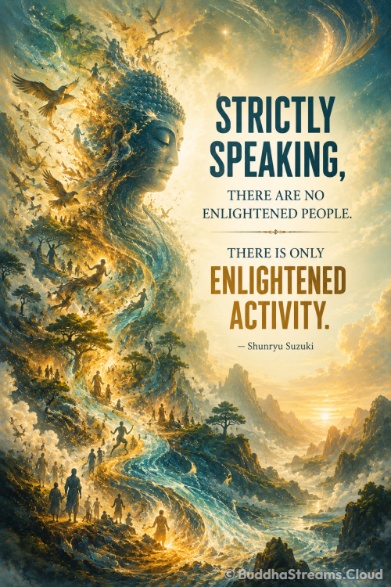
We imagine enlightenment as something you become, a permanent condition, a graduation you reach and then possess forever. Suzuki dismantles this image gently. Enlightenment is not a noun. It is not a state. It is a verb. It is what happens in moments of genuine presence, complete honesty, real compassion, and clear seeing. You cannot own it. You cannot achieve it once and retire. It is available in every moment. But it must be renewed in every moment. This is good news. It means it is always close.
5. When you bow, you should just bow. When you sit, you should just sit. When you eat, you should just eat.
— Shunryu Suzuki
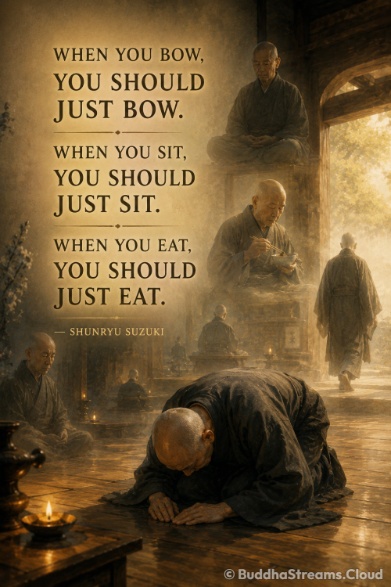
The word just is doing enormous work in this teaching. Just bow. Not bow while thinking about your next appointment. Not eat while scrolling. Not sit while planning the rest of your day. Just. One thing. Completely. Suzuki is not describing a special spiritual state reserved for monks. He is describing any ordinary moment inhabited with absolute wholeness. When you are just eating, you taste the food. When you are just listening, you actually hear the person. The just is the teaching. The just is the whole practice.
6. Each moment is absolute, whole, and significant.
— Shunryu Suzuki
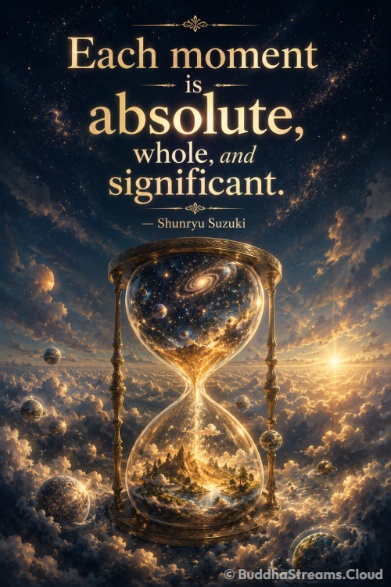
The snowflake is the most honest teacher of impermanence. Perfectly formed. Complete in itself. And gone in seconds. Suzuki is pointing to every moment of your life with this kind of reverence. Not just the peak moments, the weddings and the breakthroughs and the sunsets. The ordinary ones too. The Tuesday morning coffee. The brief conversation by the elevator. The moment before sleep. Each one is whole. Each one is unrepeatable. Each one is already gone. Pay attention.
7. Wherever you go, you are one with the clouds and one with the sun and one with the rivers and mountains.
— Shunryu Suzuki

The sense of separation from the natural world is one of the great sorrows of modern life. We live inside, we work inside, we stare at screens, and we gradually forget that we are made of the same elements as rivers and clouds. Suzuki is not speaking poetically here. He is making a literal claim. You are not separate from the world. You belong to it completely. And when you remember this, even briefly, the loneliness that so many of us carry quietly eases just a little. You were never actually alone.
8. The way to practice without having any goal is to limit your activity, or to be concentrated on what you are doing in this moment.
— Shunryu Suzuki
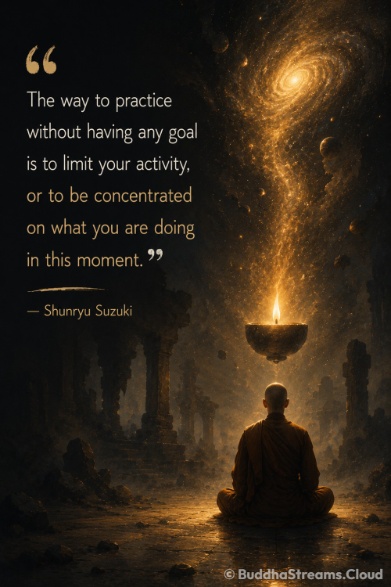
Goal-oriented practice is not wrong. But it carries a hidden cost. When every moment of practice is oriented toward a future result, the present moment is constantly being used as a means to something else. It is never simply enough in itself. Suzuki offers an alternative: concentration so complete that the question of where you are going simply does not arise. You are entirely here. This is not laziness disguised as philosophy. It is one of the most demanding and most liberating forms of practice available.
9. If you want to obtain perfect calmness in your zazen, you should not be bothered by the various images you find in your mind.
— Shunryu Suzuki
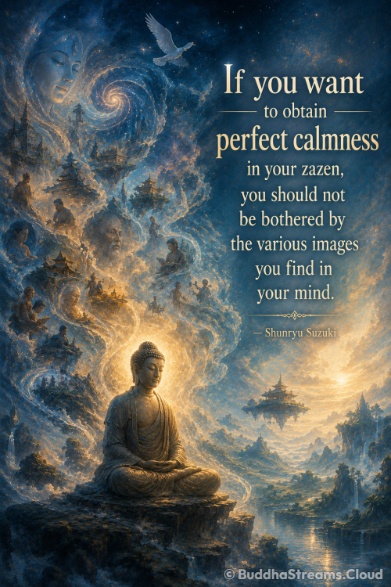
Meditation beginners often believe the goal is to achieve a mind free of thoughts. When thoughts keep arriving, they feel they are failing. Suzuki gently corrects this. Thoughts are clouds. They come and go. The practice is not to erase them but to stop being so troubled by their arrival. You are the sky, not the clouds. The sky is never stained by what passes through it. Each difficult thought that you watch without grabbing onto is itself the practice. You are not doing it wrong. This is what it looks like.
10. Your imperfect practice is enough for the Buddha to smile.
— Shunryu Suzuki
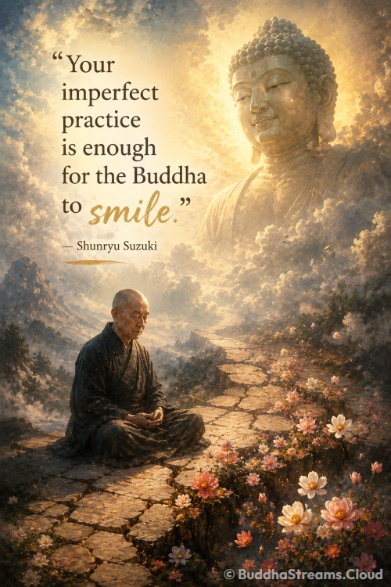
There is tremendous relief in this teaching. You do not have to be good at this. You do not have to be consistent, disciplined, or particularly calm. Your sincere, imperfect effort, the morning you sit for only three minutes before the children wake up, the moment you catch yourself reacting and pause, the day you try again after a week of forgetting to try, all of it is enough. Suzuki is telling you that the practice meets you where you are. Not where you think you should be.
11. In the beginner’s mind there is no thought ‘I have attained something.'”
— Shunryu Suzuki
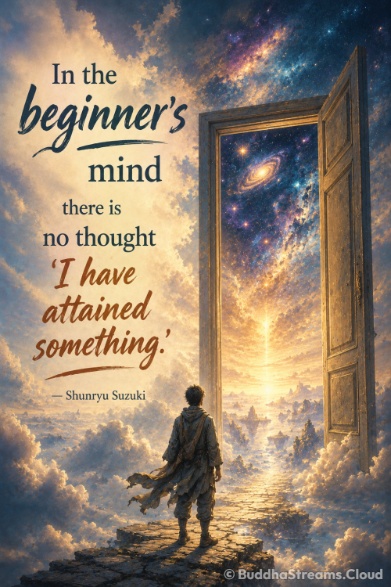
The moment we start keeping score, something shifts in the practice. We begin performing for an imaginary audience. We begin protecting a spiritual reputation we have started to build. Suzuki is pointing out that this accumulation of spiritual achievement is the opposite of what the practice opens up. In genuine beginner’s mind, there is nothing to protect because nothing has been claimed. This is not an absence. It is the most spacious and free way a human being can move through life. Holding nothing. Open to everything.
12. To be yourself is to be beyond yourself.
— Shunryu Suzuki
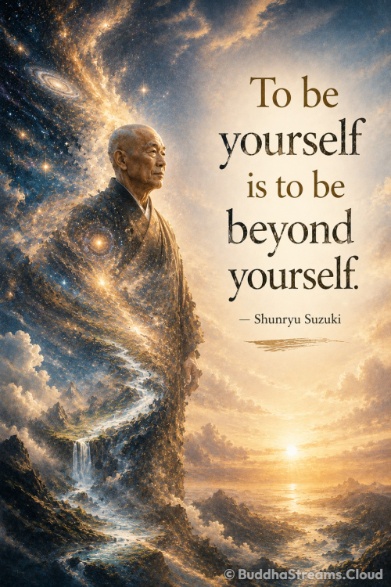
The truest version of yourself is not the defended, curated, performance-managed version. It is something more open, more honest, more connected than that. When Suzuki says to be yourself, he is not encouraging self-indulgence. He is pointing toward the self that appears when all the performance falls away. And that self, the genuine one, turns out to be far larger than the small self we thought we were being so careful to protect. Being truly yourself always turns out to be more than yourself.