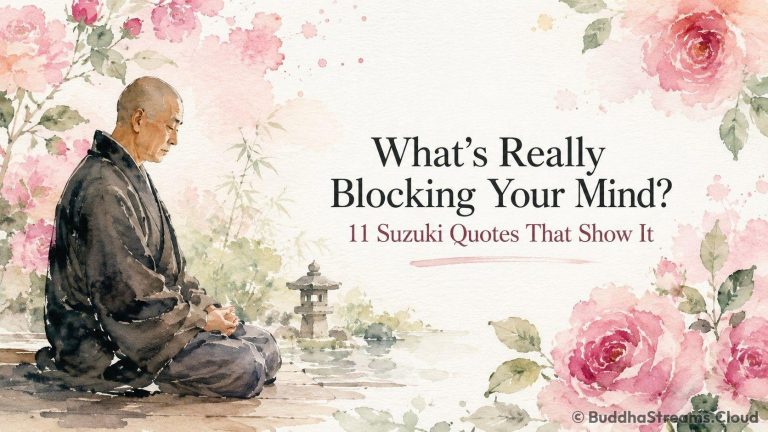

11 Shunryu Suzuki Quotes That Will Restore Your Sense of Wonder
1. In the beginner’s mind there are many possibilities, but in the expert’s mind there are few.
— Shunryu Suzuki
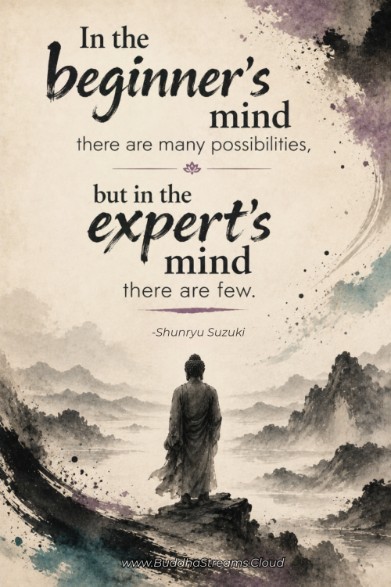
Expertise is extraordinarily useful. But it also builds walls. The more certain we become about how things are, the harder it becomes to see how things could be. A child in front of a pile of cardboard boxes sees a castle, a spaceship, a city, a hundred things at once. The experienced adult sees cardboard. Suzuki is not asking us to become naive. He is asking us to stay curious. To approach even the familiar with a question instead of a conclusion. That openness is where new things can enter.
2. If your mind is empty, it is always ready for anything. It is open to everything.
— Shunryu Suzuki
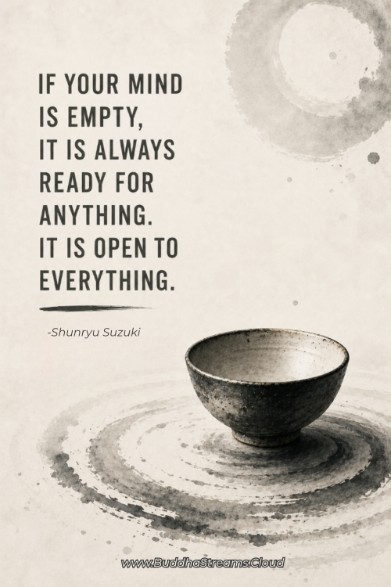
We spend a great deal of effort filling ourselves up. Knowledge, opinions, certainties, beliefs, schedules, identities, all packed in tightly. But Suzuki suggests that the value of a bowl is not in what it holds but in the fact that it is hollow. An empty bowl can receive anything. A full one cannot receive anything more. The practice of beginner’s mind is the practice of making room. Setting down what you are certain of long enough to discover what you might have been missing.
3. The most important thing is to find out what is the most important thing.
— Shunryu Suzuki
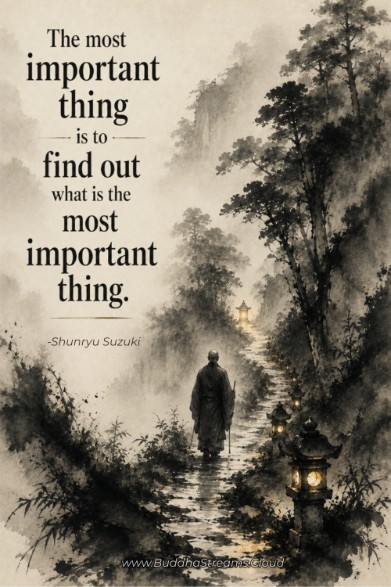
This may sound circular at first. But sit with it for a moment. Most of us spend our energy on what is urgent rather than what is important. We respond to what is demanding rather than what is meaningful. Suzuki is asking a deeply serious question and asking us to take it seriously. Not what does the world want from you today. But what actually matters most in the larger story of your life. That question, asked honestly and regularly, is itself a practice. The answer will surprise you.
4. Without accepting the fact that everything changes, we cannot find perfect composure.
— Shunryu Suzuki
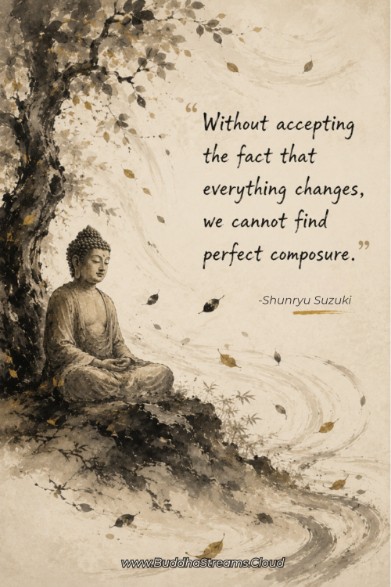
We often try to create peace by trying to make things stay the same. By holding on tight to what feels good and pushing away what feels threatening. Suzuki is telling us this effort is the source of our agitation, not the solution to it. True composure does not come from successfully freezing anything in place. It comes from the willingness to let everything move as it will, while remaining steady at the center. Not rigid. Not gripping. Simply present to whatever arrives next.
5. Each of you is perfect the way you are, and you can use a little improvement.
— Shunryu Suzuki
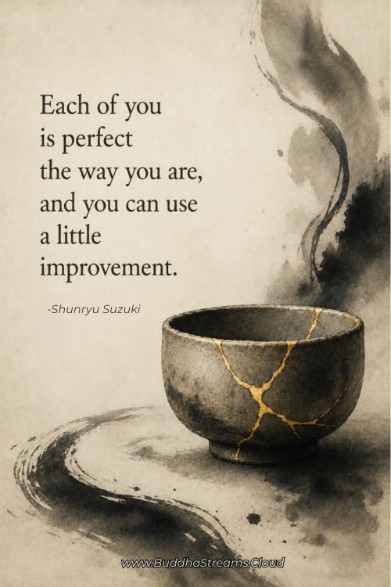
This sentence is a small masterpiece of paradox. You are already enough. And growth is still possible. Both of these things are completely true and not in conflict with each other. So often we feel we must choose. Either I accept myself as I am or I try to improve. Suzuki is freeing us from that false choice. You can love yourself completely and still be curious about who you might become. Wholeness and growth do not cancel each other out. They live together quite comfortably.
6. The goal of practice is always to keep our beginner’s mind.
— Shunryu Suzuki
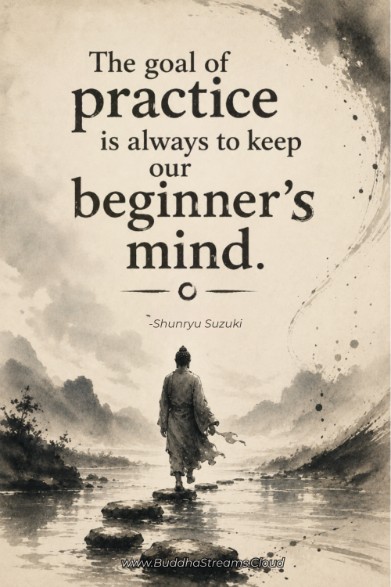
There is a version of long practice that calcifies. That becomes mechanical and dull. That turns the living thing of spiritual engagement into a routine performed out of habit. Suzuki is warning us about this. The goal is not mastery in the sense of no longer needing to pay attention. The goal is the opposite: to remain so open, so present, so undefended that every sitting, every breath, every ordinary moment still has the power to surprise you. Decades of practice, and still a beginner. That is the real achievement.
7. When you do something, you should burn yourself up completely, like a good bonfire, leaving no trace of yourself.
— Shunryu Suzuki

There is an aliveness in complete commitment that half-commitment can never access. Think of the musicians who disappear into the music. The athletes who stop hearing the crowd. The writers who surface from their work hours later, astonished that time has passed. That is what Suzuki is describing. When you bring your whole self to what you are doing, when nothing is held back in reserve, something extraordinary can happen. The self steps aside and something pure and free comes through. Leave nothing in reserve. Burn completely.
8. We have to take care of ourselves in a generous and warm way.
— Shunryu Suzuki

Self-care is not indulgence. For Suzuki, caring for oneself with generosity was not separate from the practice. It was the practice. You cannot offer warmth to others from a cold and depleted place. You cannot hold space for the pain of others if you have been relentlessly harsh with yourself. The same quality of tenderness you might offer a dear friend in distress is exactly what you deserve to offer yourself in your own hard moments. Generosity begins at home. In your own chest. In how you speak to yourself when no one is listening.
9. To have some deep feeling about Buddhism is not the point; we just do what we should do, like eating supper and going to bed.
— Shunryu Suzuki
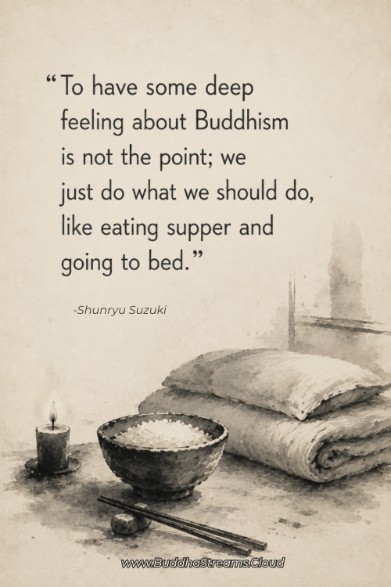
We sometimes wait for spiritual feeling to motivate spiritual action. We want to feel moved, inspired, connected before we sit down to practice. Suzuki completely dismantles this dependency. The practice is not sustained by feeling. It is sustained by showing up, the way you show up to eat, without waiting to feel enthusiastic about dinner. The feeling comes sometimes. Sometimes it does not. The practice continues regardless. This is the quiet backbone of a real spiritual life. Not inspiration. Commitment.
10. If you are too idealistic, you will not find anything.
— Shunryu Suzuki

The search for the perfect meditation, the perfect teacher, the perfect moment of enlightenment can become its own obstacle. We can spend so long looking for the ideal practice that we never actually practice. Suzuki is gently grounding us here. The flowers are at your feet, not in some imagined perfect sky. The practice available to you right now, imperfect, inconvenient, messy, is infinitely more valuable than the ideal practice you are still waiting to arrive. Start with what is actually here. That is always enough.
11. Calmness of mind does not mean you should stop your activity. Real calmness should be found in activity itself.
— Shunryu Suzuki
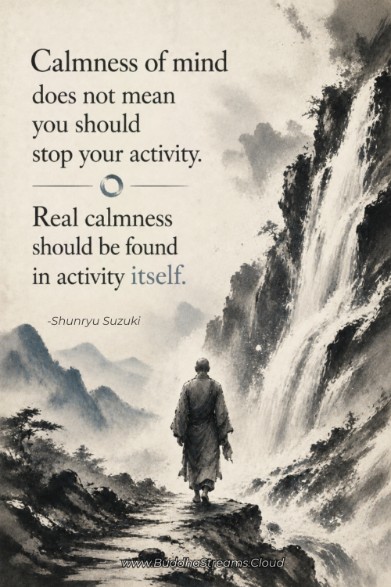
Stillness is not the absence of movement. That is a common misunderstanding about contemplative practice. Real stillness, the kind Suzuki is pointing to, is the quiet center that remains unshaken even while everything around you is moving. You can be in the middle of a demanding day, a difficult conversation, a complicated task, and still maintain a clear and rooted inner quality. This is not achieved by slowing down. It is achieved by bringing full presence to the speed. The calm is always available. It does not require quiet to arrive.