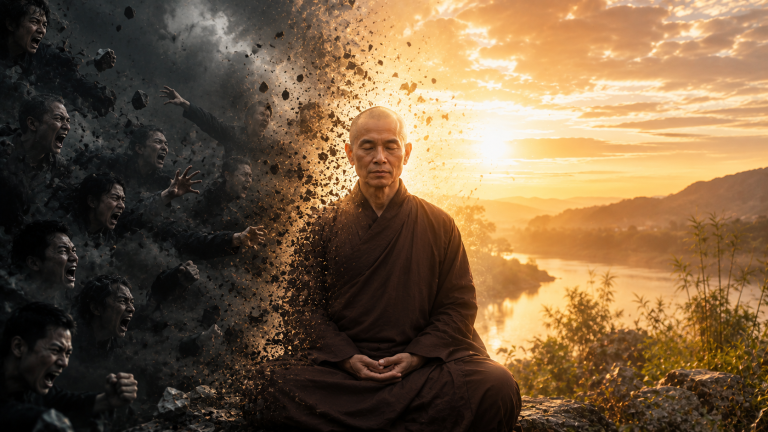

You’re Living Time All Wrong — 10 Dogen Quotes That Break Reality
1. Impermanence is itself Buddha nature
— Dōgen Zenji
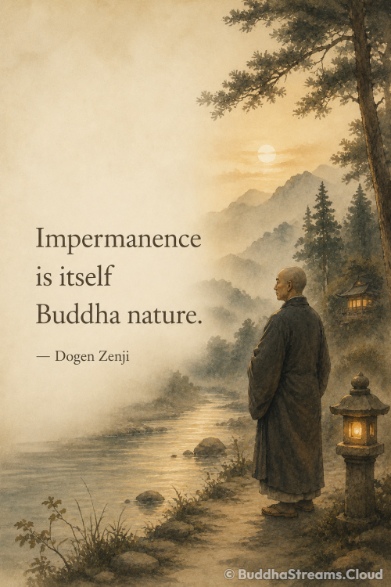
We resist impermanence with tremendous energy. We photograph what we love, we try to freeze it, preserve it, hold onto it just a little longer. Dogen offers a radical reframe. The very fact that nothing lasts is not the tragedy. It is the teaching. It is the nature of awakening itself. Because impermanence means every moment is alive, fresh, unrepeatable. A flower that bloomed forever would stop being beautiful. It is the falling that makes it precious. Impermanence is not the opposite of the sacred. It is the form the sacred takes.
2. Do not think that time simply flies away. Do not understand flying to be the only function of time.
— Dōgen Zenji
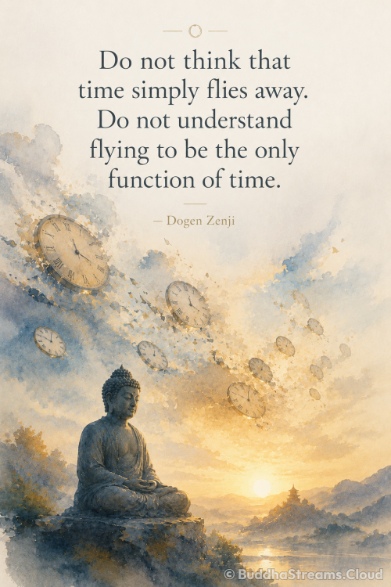
We speak of time passing as though it is always running away from us. Dogen asks us to look more carefully. Time does not only fly. It arrives. It settles. It deepens. Some moments expand rather than contract. Some hours hold more life than entire years of distracted living. How we relate to time shapes what time does to us. When you sit fully in a moment without rushing it, time reveals itself to be something far stranger and more generous than a straight line disappearing behind you.
3. The whole moon and the entire sky are reflected in one dewdrop on the grass.
— Dōgen Zenji
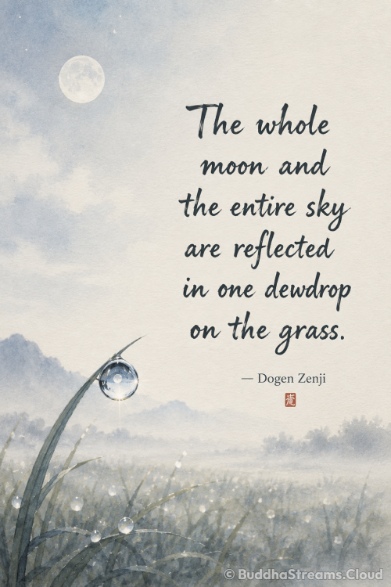
One small thing can contain everything. One conversation can open a life. One question can unravel decades of confusion. One breath, taken fully, can hold the depth of an entire universe. Dogen is pointing us to the infinite inside the ordinary. We go looking for vastness in enormous things, in grand experiences and sweeping landscapes, when the whole sky is right there in the smallest drop of water beside your foot. Everything is present in everything. You only have to be small and quiet enough to see it.
4. Be the master of your own fate. Be the master of your own mind.
— Dōgen Zenji
Mastery of fate does not mean controlling every outcome. It means responding to what arises from a place of clarity rather than reaction. Mastery of the mind does not mean silencing every thought. It means not being dragged around helplessly by every thought that passes through. Dogen is pointing to an inner sovereignty that has nothing to do with external power. When your mind is steady and clear, the circumstances of life lose their ability to dictate your experience. That steadiness is cultivated. It does not arrive by accident.
5. Those who see worldly life as an obstacle to dharma see no dharma in everyday actions.
— Dōgen Zenji
It is tempting to separate spiritual life from regular life. To save the sacred stuff for meditation cushions and retreat centers and leave the rest of existence as spiritually neutral territory. Dogen refuses this separation completely. Cooking, sweeping, washing, working, arguing, reconciling, all of it is the territory where the dharma lives and breathes. If the practice cannot survive contact with an ordinary Tuesday afternoon, it was never a real practice. The monastery, Dogen reminds us, is everywhere.
6. To give life to both good and evil things is a great delusion.
— Dōgen Zenji
We construct elaborate universes of good and bad, worthy and unworthy, sacred and profane. And then we suffer endlessly when life refuses to stay neatly in those categories. Dogen points to something liberating beyond the label-making mind. Events are not inherently good or evil. They are what they are. The suffering comes from the story we insist on layering over them. This is not moral relativity. It is an invitation to see more clearly, to respond more wisely, to suffer less from your own certainty about what things mean.
7. There are those who, upon realizing the truth, become attached to the realization.
— Dōgen Zenji
Even awakening can become a possession, a trophy, an identity to protect. This is one of the subtler and more human traps on the spiritual path. You have a profound experience, a deep insight, a moment of real clarity, and the next thing you know, you are building your identity around having had it. Dogen is pointing gently at the trap here. Realization is not a destination. It is a direction. The moment you clutch it and call it yours, it begins to harden into just another concept, which is exactly what it was meant to dissolve.
8. The true practice is to face reality directly, without any shield.
— Dōgen Zenji
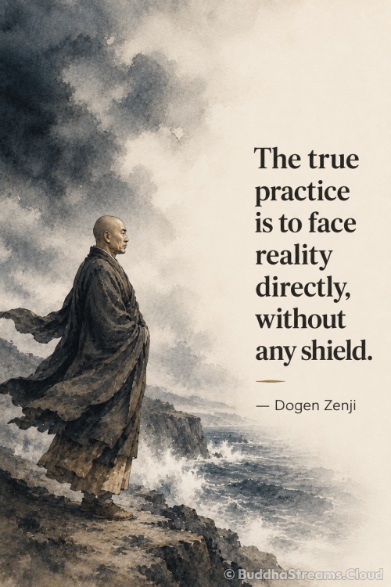
We build so many shields. Busyness, irony, cynicism, distraction, numbness, all of them serving the same purpose: keeping reality at a manageable distance so we do not have to feel it fully. Dogen is asking something genuinely courageous of us. To put the shields down. To let what is true actually arrive. To feel the grief when grief is present. To feel the joy when joy arrives. To let life touch you. This is not weakness. It is the most direct path through everything you are afraid of.
9. We must always be absorbed in thought, absorbed in practice, absorbed in action.
— Dōgen Zenji
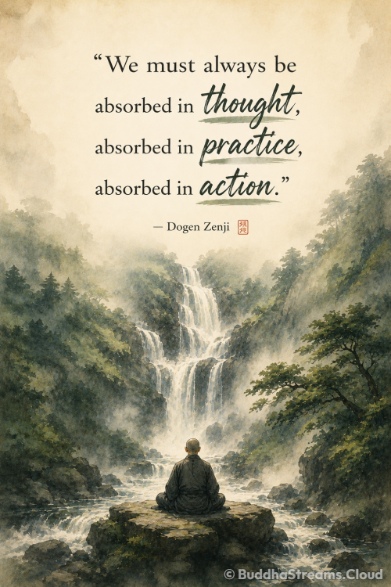
Half-presence is a kind of poverty. To be physically somewhere but mentally elsewhere, to go through the motions without inhabiting them, leaves both you and everything around you only half-lived. Dogen is describing something that feels almost old-fashioned today but is actually profoundly countercultural. Complete absorption. Full commitment to what is in front of you. Not multitasking. Not optimizing. Simply being completely here for what you are doing. In that complete presence, something ordinary becomes something holy.
10. The ancient Buddha said: Mountains are mountains, waters are waters.
— Dōgen Zenji
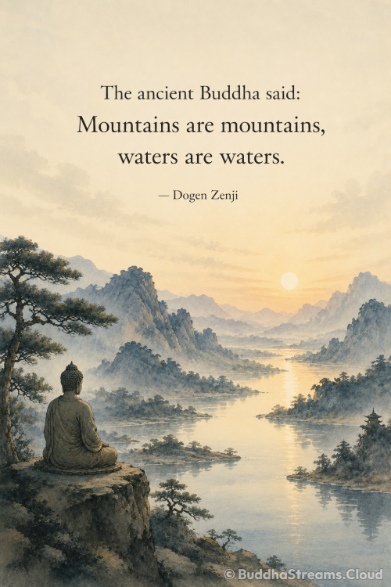
There is a famous progression in Zen. At first, mountains are mountains. Then, after much study, mountains are no longer mountains. And finally, mountains are mountains again. This is not a circle of confusion. It is a spiral of deepening. We begin with simple perception. Study reveals complexity and interdependence that undoes our certainties. And then, having moved through all of that, we arrive back at simple clear seeing, mountains exactly as they are, waters exactly as they are. Understanding does not complicate life. Eventually, it simplifies it back into wonder.