
What’s Really Blocking Your Mind? 11 Suzuki Quotes That Show It
1. Zen is not some kind of excitement, but merely concentration on our usual everyday routine.
— Shunryu Suzuki
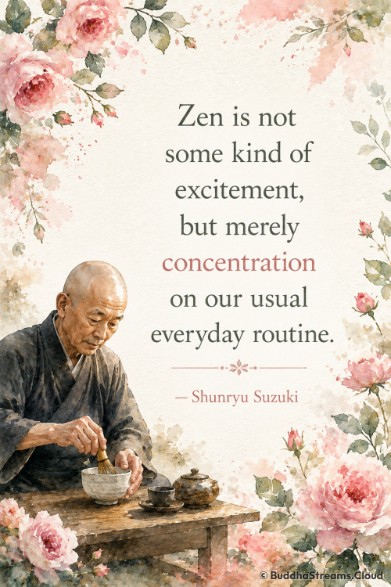
We sometimes come to spiritual practice looking for drama. For visions, for ecstatic states, for some experience that will confirm we are finally on the right path. Suzuki quietly lets the air out of this expectation. Zen is not the extraordinary. It is the ordinary, lived with extraordinary attention. The same kitchen, the same walk to work, the same cup of morning tea, but approached with complete presence. The practice does not remove you from regular life. It asks you to finally arrive in it.
2. Rather than having a deep meaning, everything in life is a pure expression of our nature.
— Shunryu Suzuki

We are meaning-making creatures by nature, and this is one of our gifts. But sometimes the search for deep meaning in everything becomes an obstacle to simply being here, experiencing what is actually happening. Suzuki invites a kind of rest from the search. What if the bird singing is not a symbol? What if the rain is not a message? What if it is simply the world being what it is, fully and completely, without needing to mean anything more than itself? That acceptance is a form of deep peace.
3. It is easy to have calmness in inactivity. It is hard to have calmness in activity.
— Shunryu Suzuki
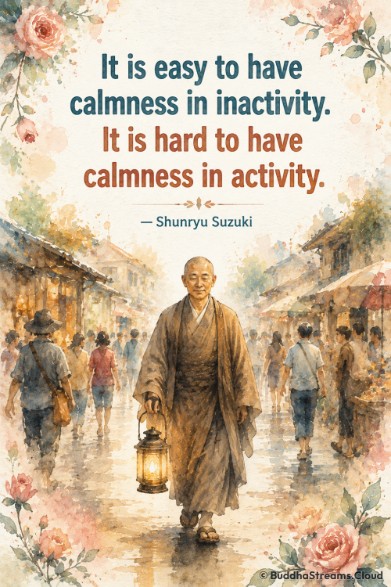
Retreats are wonderful. Quiet mornings are wonderful. Moments of solitude where there is nothing demanding anything of you, these are genuine gifts. But they are not where the practice is actually tested. The test is Wednesday afternoon in a difficult meeting. The test is when the day is not going the way you planned and every small thing is going wrong. Suzuki is asking us to bring the stillness we find in quiet into the fullness of an ordinary demanding life. This is harder. This is also more important.
4. When you try to attain something, your mind starts to wander about somewhere else.
— Shunryu Suzuki

The very act of striving for a spiritual goal often pulls us away from the only place where the goal could ever actually be found. If enlightenment is here, then the reaching for it in the future is what obscures it. This sounds paradoxical, but it points to something genuinely subtle and important. Relaxing the grasping is itself the practice. Not because you do not care about awakening, but because the tight hand of wanting is the very thing that keeps it out of reach. Open the hand. Let the practice land.
5. People say that practicing Zen is difficult, but there is a misunderstanding.
— Shunryu Suzuki
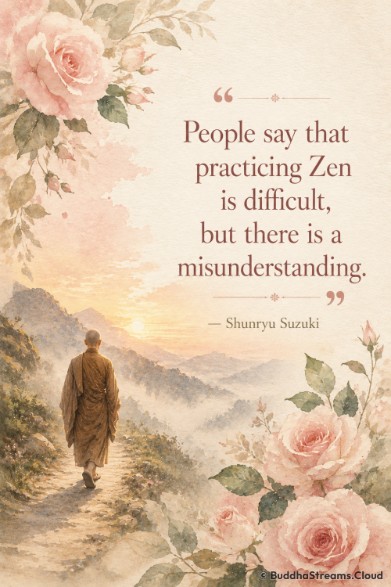
We overcomplicate spiritual practice before we even begin it. We decide it requires a certain lifestyle, certain credentials, a certain level of readiness we have not yet achieved. Suzuki says this is the misunderstanding itself. The practice is not harder than simply being alive with attention. Which you already know how to do. You are doing it right now. The difficulty is not in the technique. It is in consistency. In choosing to return, again and again, to what you already know how to do.
6. As soon as you see something, you already start to intellectualize it. As soon as you intellectualize something, it is no longer what you saw.
— Shunryu Suzuki
The mind is extraordinarily fast. By the time we notice something, we have often already categorized it, named it, related it to something we already know, and stored it away. The actual thing itself, the raw, living, uncategorized reality of it, has already been replaced by our idea of it. Suzuki is inviting us to slow this process down. Not to stop thinking, but to notice the moment just before thinking begins. That moment of pure seeing. It is brief. And it is more real than any label we apply afterward.
7. To accept some idea of truth without experiencing it is like a painting of a cake, which cannot satisfy hunger.
— Shunryu Suzuki

Reading about compassion and actually being compassionate are two different activities entirely. Understanding the concept of impermanence intellectually and actually facing the loss of something beloved are two entirely different kinds of knowing. Suzuki is asking us to close the gap. To take what we say we believe and let it actually enter our bodies, our decisions, our relationships, our difficult moments. The understanding that stays only in the head is a beautiful picture. But only direct experience can actually nourish.
8. Our nature is always there, even though you do not notice it.
— Shunryu Suzuki

This is one of the most comforting things Suzuki ever said. Your fundamental nature, the wide, open, clear nature that Zen practice points toward, is not something you have to build or earn or achieve. It is already present. Already underneath every anxious thought, every sad morning, every difficult season. The practice is not the construction of something new. It is the gentle, patient uncovering of something that was never actually lost. It is there right now, beneath this moment, waiting to be recognized.
9. Do not be angry with someone who sometimes talks too much. We are all like that.
— Shunryu Suzuki
Spiritual life sometimes creates an unspoken pressure to become visibly better than other people. More patient. More quiet. More composed. Suzuki will not allow this. He reminds us, with a certain gentle humor, that we are all in the same boat. We all talk too much sometimes. We are all, in various ways, works in progress who cannot quite live up to our own ideals. The compassion we extend to others is the same compassion we need extended to ourselves. Knowing this makes both a little easier.
10. After you know how to practice, the more you practice, the more you can enjoy it.
— Shunryu Suzuki
Practice does not have to remain effortful forever. In the beginning, returning to the cushion requires discipline. Showing up requires commitment. But something shifts over time. The practice begins to feel less like a task and more like a refuge. Less like discipline and more like pleasure. Suzuki is encouraging us to stay long enough for this shift to happen. Do not quit before the practice becomes something you actually want to return to. Consistency is the seed. Enjoyment is what eventually grows.
11. You are perfect as you are. And you can use a little improvement.
— Shunryu Suzuki
This teaching is gentle enough to return to many times in a life. You are not broken. You are not behind. You are not failing at being human. And at the same time, there is more space to grow into, more kindness to develop, more understanding available to you. Suzuki holds both of these truths with equal warmth and expects us to hold them both as well. You can accept yourself completely and remain curious about becoming. These two things, together, are the foundation of a genuinely peaceful life.